

The United States Fish and Wildlife Service (USFWS) has a wonderful resource for identifying birds by their feathers, or referencing and studying different types of feathers. This includes which part of the bird a feather has come from, and the terminology of feathers. This atlas is a wonderful educational and research asset that is being added onto regularly.
Notice
This is a region-specific tool for North America.
What is the Feather Atlas?
The feather atlas is an exceptional database of feather imagery, dedicated to identifying and studying flight feathers of the birds of North America. This database is curated by the USFWS’ forensics laboratory, which is the only lab in the world devoted to wildlife law enforcement.
As of the time of this writing on HerbSpeak, the feather atlas represents a total of 438 species in its database. The database was updated relatively recently, with March 7, 2025 listed on the website, lending credibility to the idea that is still in progress and will continue to update with new species and photographs when available or necessary.
The site is well linked so you can navigate to most any other related page from the content, but you also have several helpful navigational links at the top, below the USFWS logo and heading. There are the following sections:
- Identify My Feather
- Browse Scans
- Search Scans
- Glossary
- More Information
It’s important to note that no birds are killed to create the atlas. They only come from dead birds that the agency collects through their work. The FAQ present on the atlas is full of helpful information about the website, it’s scope, and working details.
Feathers Are Protected Under Federal Law
The USFWS does note that it is, under the Migratory Bird Treaty Act, illegal to possess feathers from any bird outside of legally hunted waterfowl and gamebirds, and that anyone looking to possess feathers for educational or research purposes must apply for a federal and state permit, with an exemption only for Native Americans’ use of feathers.
Features of the Atlas
Browse
Organized by taxonomic group, browsing allows you to explore all scans within the Feather Atlas. Clicking into their browse feature, you get the option to Browse by Order, selecting from silhouettes of representative birds. Below each linked order is their common name in English, and how many species are present in the database. At the time of this writing, there are 24 orders represented in the browse section.
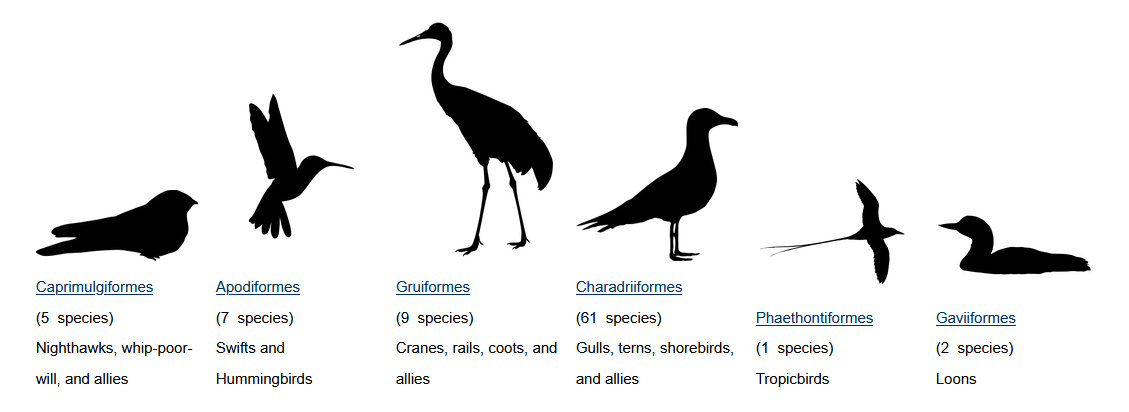
Clicking into an order gives you a list of the family names and descriptions, which you must select one of to get to the scans available of all species represented in the database for that family.
Before clicking into an Order, you also have the option to follow on-page links to All Species, All Scans, and their search engine. The search page is covered in the next heading.
Clicking to All species allows you to browse a list of common and scientific names, in alphabetical order of their common name.
Selecting the All Scans hyperlink does the same thing as performing a blank search in the search engine, providing you with a notated list of all 1994 feather scans in the database. Listed columns of information include common name, scientific name, feather type, age, sex, and any notes about the scan.

Search
Going to the search engine allows you to type in your search by order, family, common name, or scientific name.
A fun little note from whomever made the database: every time you refresh the page, a new feather image appears on the righthand side. This only appears on a full-width desktop browser, however, so mobile users may not be able to see this.
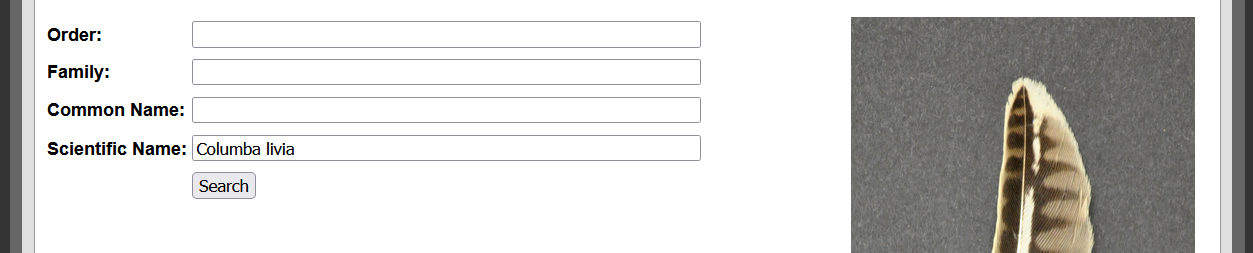
You can search with just one of the prompt boxes (such as, only within an order), or you can perform a partial search. The search “sci” in the scientific name box has 6 results with all scientific names that contain those characters. For example, Chamaea fasciata appears in this list.
You must search the correct input types. For example, searching for “pigeon” in the scientific name box will not yield anything, but searching for that same term in the common name box will provide you with 7 results.
As noted in the above section, you can also search with all blank values to see all feather scans in the database. The search feature is nice versus browse because you can quickly find your way to the image thumbnails, whereas browse requires you to click into Order > Family first.
Identify
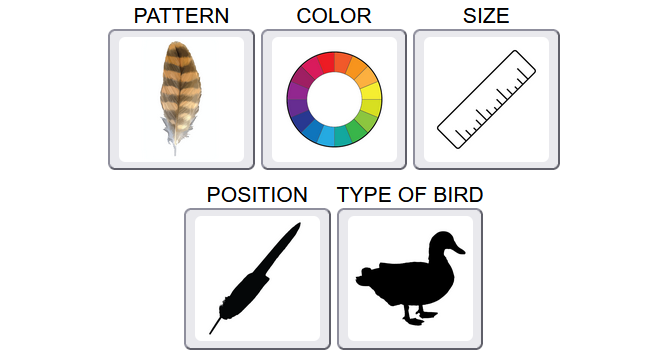
The identification tool is a novel concept, providing you with an identification key for different types of feathers. You have several criteria to select from: pattern, color, size, position, and type of bird.
Clicking different criteria will give you selection choices. You can either select one yourself, or go down the list with your selections, choosing the “Next Selection” button. Your feather information is saved until you navigate to another page.
Very helpfully, all relevant criteria provide pictures for easy identification. The only multiple-choice lists are for Type of Bird and Size. There is also additional reading linked in some of the choices to help you make more difficult choices.
Quick Tip
If you are uncertain about your criteria, like an identification key, it is better to leave that information out than to take a wild guess and possibly start off down the wrong path.
Once you’ve made your selections, select Find Similar Feathers and you’ll be brought to a list of possible matches and their image thumbnails.
Glossary
This is an incredibly helpful educational tool for anyone interested in the terminology of different feathers. Featuring both a pictorial and text glossary, it is easy for a layperson to look at and learn exactly what each part of a feather is called, as well as the placement of different feathers on a bird’s wing.
More Information
Here you have additional information regarding how feathers are treated under the Migratory Bird Treaty Act, how to identify feather position, about the methodology at the forensics lab, and more information about how the scans themselves were created.

Individual Feather Pages
Each individual feather page is a love letter to data. It’s a poetic way to say it, but you have a beautiful set of records and pictures to help you with your feather-related needs.
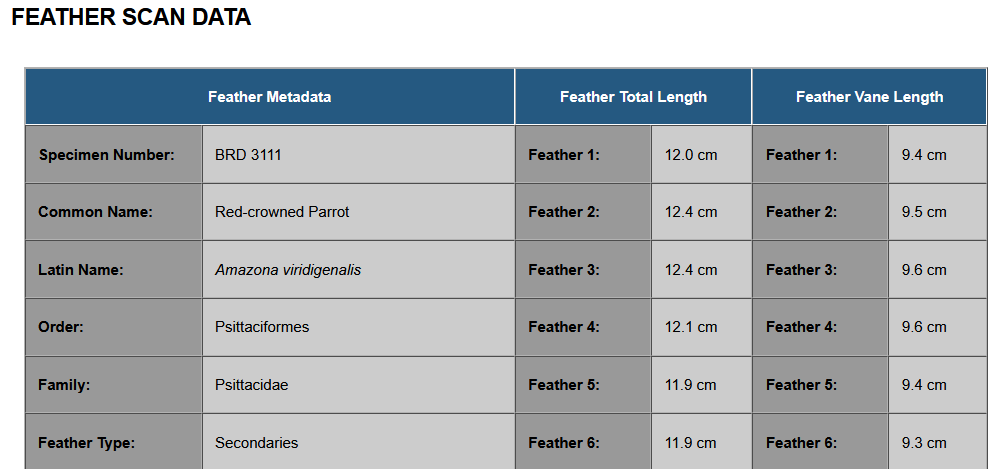
The individual feather pages will have all the relevant information right at the top: Scan ID, common name, scientific name, the life stage of the bird, and the gender of the bird. Below that, you have an image of the feathers, laid out and scanned in a methodical sequence. They are on a single-color background with identifying information and a centimeter grid.
Below that, you have feather scan data from the actual database. Everything from where the bird was collected, the specimen number, the feather and vane measurements of this particular bird.
Finally, there are additional images with more feather scans. Everything that you could possibly ask for in an atlas.
0 Comments