
Notice
This is a region-specific tool for the contiguous United States, which excludes Hawai’i and Alaska.
There are more resources on HerbSpeak
About BirdCast: Real-Time Migration Forecasts
BirdCast is a project of the Cornell Lab of Ornithology that began in 1999 that is dedicated to determining when and where birds migrate on a daily basis using real-time weather radar. It also set out to determine how far these migrations will go, and even begin forecasting them based on migration patterns. Funded by several organizations and made possible by the participation of scientists from several academic institutions, which you can find on their About page, BirdCast is still an active project that is continuing to develop and expand today.
There are several migration tools available developed using radar technology. The first is live maps, which tells you how much, where, when, and in what direction nocturnal bird migration is occurring in real time.
Then, there are Forecast maps, which works to forecast how many birds will be migrating nocturnally, as well as where and when they will be migrating.
You can also set up a local dashboard for county and state details, or get migration alerts when intense bird migration will be occurring in many cities within the United States.
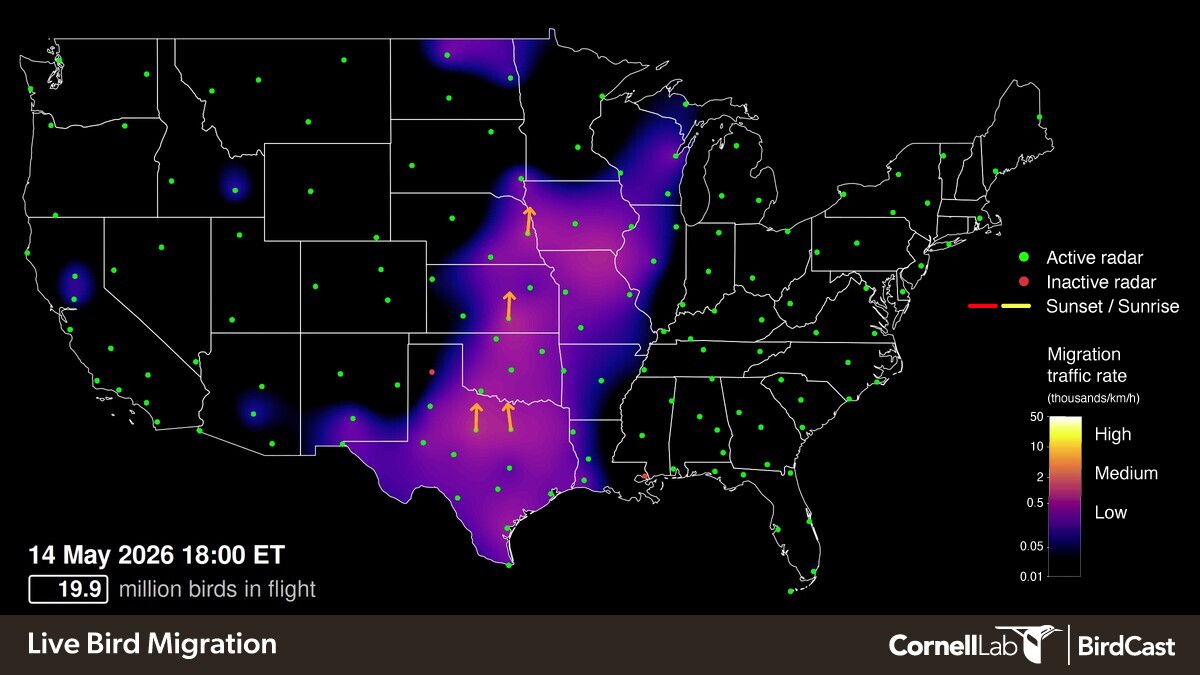
Live Maps
Live maps utilize the United States’ weather surveillance radars to detect echoes of birds’ movements. Data collected showcases how many birds are present in an easy heatmap format, and what direction they are moving with in-map directional arrows.
The map contains a time-based slider, and you can either click next or previous buttons to scroll manually through, or use the Play button to see an updating visual. The date dropdown to the left of the map allows you to view different days.
Overall, there is beautiful data visualization in these live maps, and they are worth taking a look at even if you don’t have a specific use-case for it.
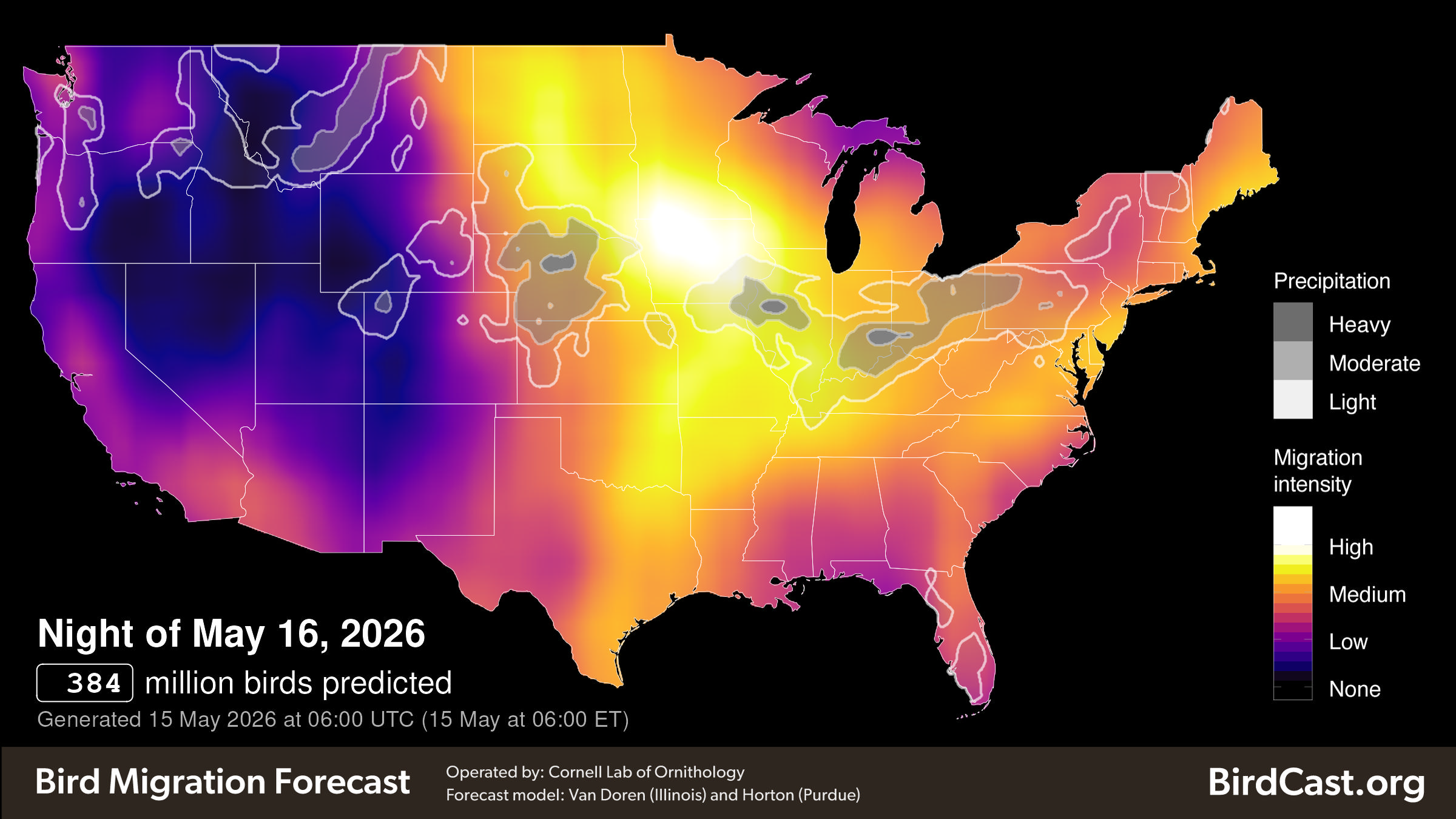
Forecast Maps
Forecast maps predict the nocturnal migration of birds in flight, and are updated every 6 hours to stay up-to-date with time-relevant reporting. As of the time of this writing, forecast maps can be viewed up to three days in advance.
The data here is visualized again with heatmap values, except here it also includes a grayscale map of expected precipitation, which can interfere with the data capture of bird migrations.
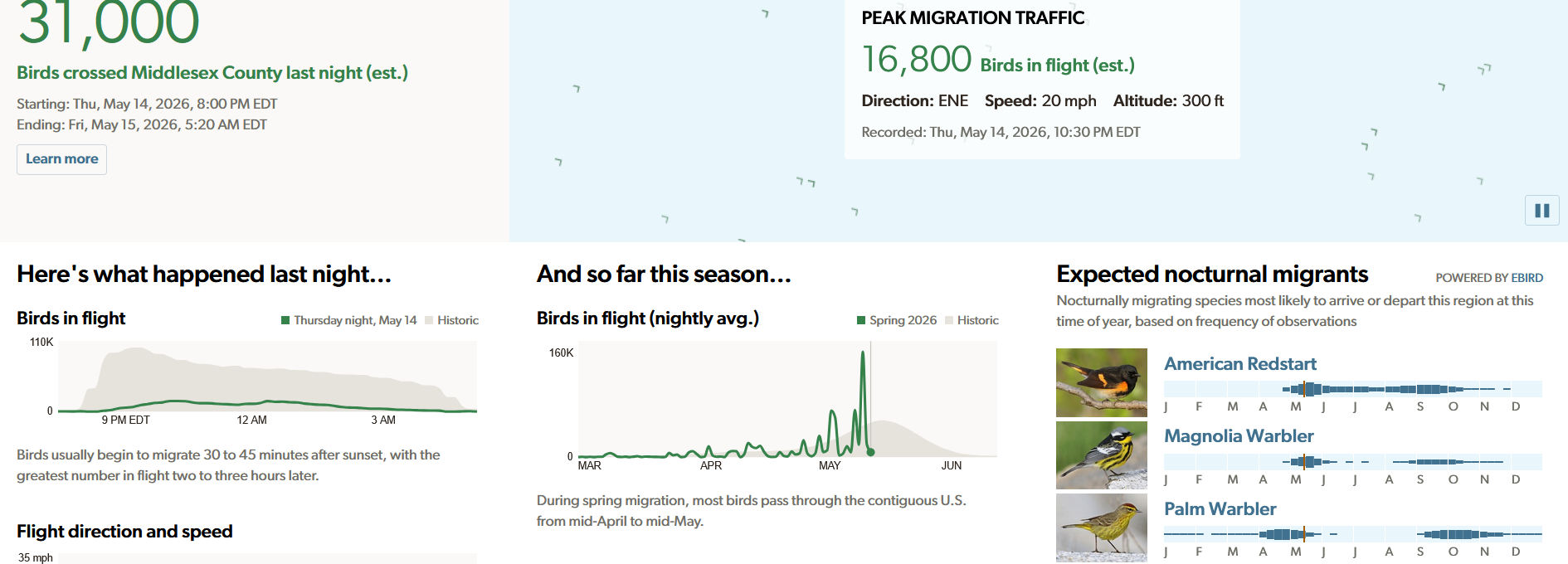
Local Dashboard
The Local Dashboard is an interesting way to explore the data that is relevant to your specific location. You can search the dashboard by county and state, then select a date. On the dashboard page, you will see a list of dashboard components explained in full, as well as a detailed guide to the dashboard in an external website.
Once you make a search, you will be sent to the dashboard for that particular county and state, for either the previous or current night depending on when you are viewing the data. You can change the date by selecting a dropdown at the top of the dashboard, as well as the locality.
If you are viewing the dashboard after sunset, you will see the live data feed. If not, you will see an estimated dataset from the previous night. Ebird data is also connected to this dashboard, showing you a list of expected migrants and their frequency on a month-to-month basis.
Migration Alerts
If you want to know when major migration events happen over your city, you can sign up for migration alerts which go to your email. By searching a city, you are brought first to a written migration forecast which covers the current night, as well as a 3-night migration forecast and the alert possibility. Low, Medium, and High migration forecasts indicate the number of (intensity) of birds migrating.
Here, BirdCast also highlights the Lights Out movement and how important it is that bird migrations are assisted by turning off artificial lights outside:
“You can still help protect any birds that pass through your region tonight by turning off all non-essential lighting from 11:00PM tonight until 6:00AM tomorrow morning. Bright lights attract and disorient nocturnally migrating birds, potentially causing fatal collisions with buildings or exposure to additional day time hazards.”
BirdCast Migration Alerts can be used to notify you of nights where it is particularly important to turn off your lights, though some number of birds migrate almost every night of the year.
About BirdCast’s Monitoring Process
BirdCast’s monitoring is not active during the winter and summer. Instead, the resources required to create the monitoring maps and access radar data is spent on periods where bird activity is at its greatest and they are able to capture the majority of species that are migrating.
According to their FAQ section, BirdCast explains that while a small number of species migrate outside of these periods, the greatest period for bird migration in the United States occurs during the spring and fall seasons. For radar monitoring, their modeling is trained on data from early March to June for spring migrations, and fall migrations begin in early August to November.
BirdCast also only reports migrations at night, where monitoring efforts are least possible. While plenty of migration reports happen during daytime hours, the night time is when birds are most actively flying and provide the most accurate results with fewer variables compared to daytime.
On their FAQ page, you can view answers to several other questions like this, as well educational FAQs about how artificial light during the nighttime is harmful to birds in their migration paths, and how you can participate in the Lights Out movement.

Additional Science Tools
Protect Birds
The Protect Birds section of the BirdCast website showcases important information about how you can protect birds during their migrations both during the day and at night from fatal collisions and disorientation. You can also download and share the graphics on this page to spread the word on social media or by printing them out to inform your community locally about these important and easy ways to protect birds.
Radar Ornithology
This section is an enlightening read on the applications and functionality of radar technology and distinction between meteorological phenomena and avian migrations. It also discusses the history of radar ornithology, and how different data are classified.
Bird Migration
In this section, BirdCast provides important educational information on the ecology and biology of bird migration, as well as peak periods of activity for those who want to learn more.
For Meterologists
BirdCast recognizes that weather and bird migrations are closely linked, and provides additional resources for meteorologists who want to talk about bird migration during their weather reports. There is an additional newsletter list for BirdCast updates for meteorologists.
References
References
References:
- BirdCast, Live Migration Map; 05/14/26 22:00. Cornell Lab of Ornithology. https://birdcast.org/migration-tools/live-migration-maps. Accessed May 15, 2026
- Van Doren, B. M., and K. G. Horton. 2018. A continental system for forecasting bird migration. Science 361:1115-1118. doi: 10.1126/science.aat7526.
- Van Doren, B. M., and Horton, K. G. 2026. BirdCast, migration forecast map; May 16, 2026 06:00 UTC. University of Illinois, Purdue University, and Cornell Lab of Ornithology. birdcast.org. Accessed May 15, 2026.
- BirdCast, Migration Dashboard; Middlesex county, Massachusetts, May 14, 8:00 PM EDT. Cornell Lab of Ornithology. https://birdcast.org/migration-tools/migration-dashboard. Accessed May 15, 2026.
0 Comments